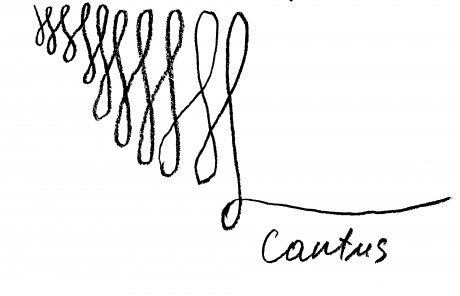
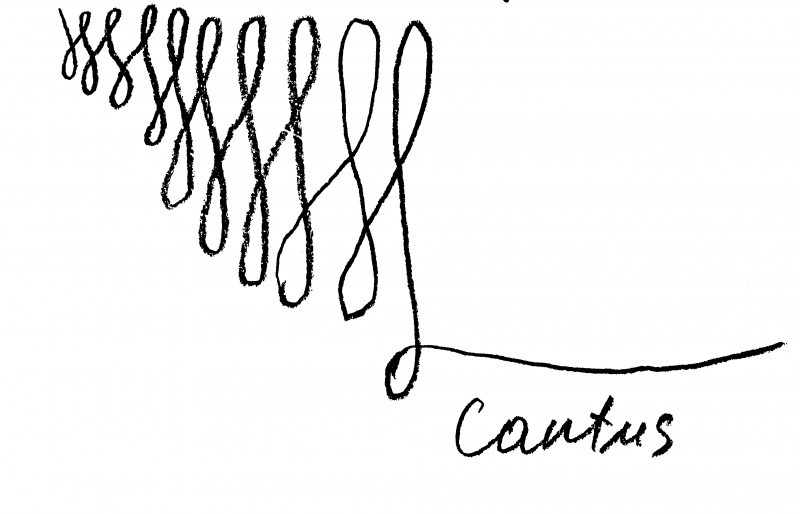
Cantus in Memory of Benjamin Britten (1977) for string orchestra and bell
On 5 December 1976, Arvo Pärt heard on the radio of Benjamin Britten’s death and was deeply affected by the news. The composer has said:
I had just discovered Britten for myself. Just before his death I began to appreciate the unusual purity of his music – I had had the impression of the same kind of purity in the ballads of Guillaume de Machaut. And besides, for a long time I had wanted to meet Britten personally – and now it would not come to that.
[Wolfgang Sandner, CD note Arvo Pärt. Tabula Rasa, ECM New Series, 1984].
Pärt was finishing an elegiac orchestra piece at the time, which he decided to dedicate to the memory of his deceased colleague, out of respect and admiration for his work.
Cantus begins with three bell tolls followed by violins, in high register, playing in the descending A minor scale. Each subsequent string group enters an octave lower, beginning their descending scale at half the speed, in what is known as the prolation canon. Thus, five layers of melody in different registers and tempos are created, accompanied by tintinnabulivoices. The slowly descending scales create an effect of endless slow-motion falling, and of peace and sadness. By the end of the composition, everything converges on the same point: one by one, the voices arrive at the low A minor chord. The entire composition resembles a single large-scale cadenza, with a tension that seems to want to avoid any final resolution.
Cantus was premiered by the Estonian National Symphony Orchestra, conducted by Eri Klas on 7 April 1977 in Tallinn, but there were already plans to perform it with the BBC Symphony Orchestra at London’s Southbank Centre in 1978, under the conductor Gennady Rozhdestvensky. However, because the Soviet authorities refused to allow the composer to travel to England, Rozhdestvesnky cancelled the performance in protest, which in turn, caused a scandal in the international media. A year later Pärt was finally granted a travel permit and Cantus was performed by the same orchestra at the BBC Proms festival.
Today, Cantus has become one of Pärt’s most popular works and is performed and heard with great admiration all over the world.
Arvo Pärt:
It is the clarity of the order that we all perceive consciously or unconsciously, so that it creates in us vibrations, a kind of resonance. Isn’t that the mystery of music, of all kinds of music?
[Enzo Restagno, Leopold Brauneiss, Saale Kareda, Arvo Pärt. Arvo Pärt in Conversation. Dalkey Archive Press, London, 2012, p. 39.]