-
Mondriaan Fonds

Site by: Rytm Interactive
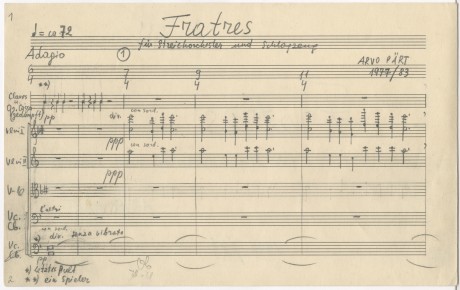
Concert recording of Fratres. ERR Klassikaraadio live broadcast from St. John's Church, Tallinn, 2.11.2015.
Fratres (Latin for “Brothers”) was composed in 1977 and belongs to the many works (Für Alina, Cantus, Tabula rasa etc.) that were created explosively after recognising the principles of tintinnabuli music.
Fratres was initially composed as three-part music without fixed instrumentation that can be performed with various instruments. This is possible using the basic principle of the tintinnabuli technique, where the musical material does not necessarily have to be tied to the timbre of a specific instrument. Such a practice was also used in Medieval and Renaissance music which Pärt intensively explored before the birth of his tintinnabuli style. The composition was premiered in 1977 by the composer’s like-minded friends from the early music group Hortus Musicus, and the original version of Fratres was also dedicated to them.
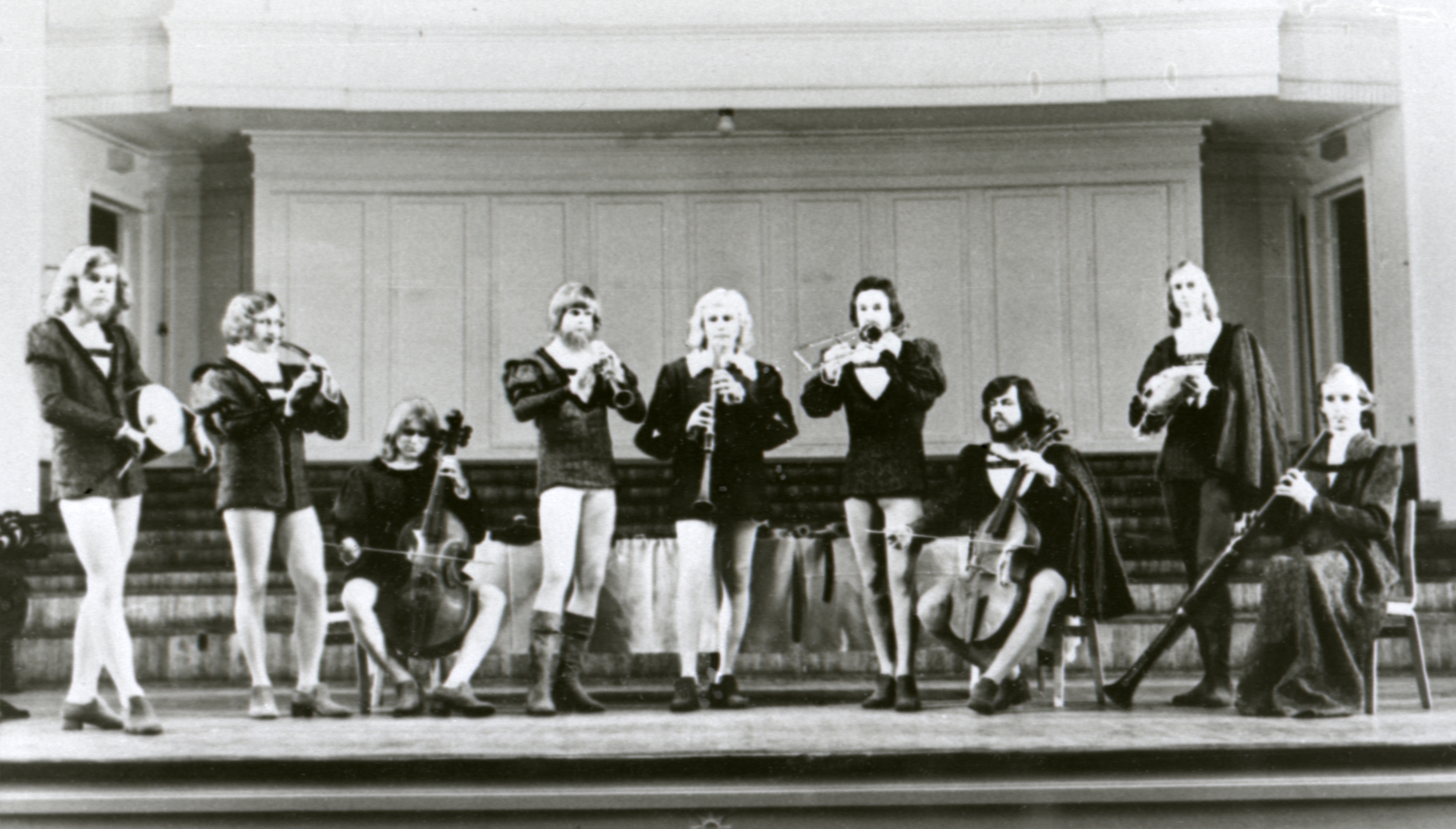
Early music ensemble Hortus Musicus at the Estonia Concert Hall, Tallinn 1977. Photo: Uno Oksbusch / Estonian Film Archive
Today, however, the catalogue of Pärt’s works includes more than 20 versions of Fratres for very different instrument combinations.
Structurally, Fratres consists of a set of variations separated by recurring percussion motifs (in the case of instrument settings without percussion, the drum-like sound is imitated). Throughout the composition we can hear a recurrent theme that starts each time in a different octave. We can clearly recognise three voices: two melodic lines mainly moving stepwise and the central tintinnabuli voice moving on the notes of minor triad. These are accompanied throughout the entire composition by a resounding low drone of fifth. Characteristically for Arvo Pärt, the apparent simplicity of the composition is governed by strict mathematical rules that determine the movement of voices, length of the melody and phrases, time signature alternations and so much more.
Fratres also exists as three-part music with added variations for the solo instrument. The first among these was written for violin and piano and was commissioned by the Salzburger Festspiele festival. It was premiered in 1980 at the festival, performed by Gidon Kremer and Elena Kremer. The technically demanding part of the solo instrument was added to the recurring three-part theme as a new layer, placing even more emphasis on the contrast between the changing and constant elements. That version too can be performed by various instrument combinations, such as a saxophone quartet or four percussionists among many others.
Fratres has become one of the best-known and most performed works by Arvo Pärt. It has been used in numerous movie soundtracks and dance shows.
See also archive recording of Fratres (excerpt) and comment by Gidon Kremer.