-
Mondriaan Fonds

Site by: Rytm Interactive
Concert recording of Symphony No. 3 at the Nargenfestival, Noblessner Foundry, Tallinn, 9.09.2011.
By the time Credo was composed in 1968, Pärt had come to the conclusion that the musical means he had been using so far had exhausted themselves. The composer then delved into early music because it was in Gregorian chant, early polyphony and polyphonic music from the Renaissance that he had previously found his musical examples, ideal sound combinations and techniques. This became the starting point for his eight-year period of searching for a unique musical language.
This silence was broken by Symphony No. 3, one of the first works that was considerably different from his earlier compositions and heralded Pärt’s new creative principles. The three movements of the composition follow each other attacca (i.e. without any break). The composer’s interest in monody and early polyphony is clearly visible here. The harmonic and melodic material brings to mind choir music from the 14th and 15th centuries, even though Pärt does not use any quotations. The polyphonic development in all movements of the piece do not emphasize the atmosphere from behind centuries, but rather, translate the thematic material into contemporary musical language. In Symphony No. 3 Pärt aimed to apply the notion of the movement of independent voices, imagining the entire structure of the composition as a metaphor for building a city.
Small, increasingly numerous centres that spread out until they touch each other and form a unity. The same thing happens with the harmonic progression in the piece that is evolved from a series of short cadences. Upon this idea is based the idea of polyphonic complexity. I had succeeded in building a bridge within myself between yesterday and today—a yesterday that was several centuries old—and this encouraged me to go on exploring.
[Enzo Restagno (2012). Arvo Pärt in Conversation. Dalkey Archive Press, p. 29]
Symphony No. 3 is dedicated to Neeme Järvi, who conducted the Estonian Television and Radio Symphony Orchestra at the premiere of the symphony at Estonia Concert Hall in Tallinn on 21 September 1972.
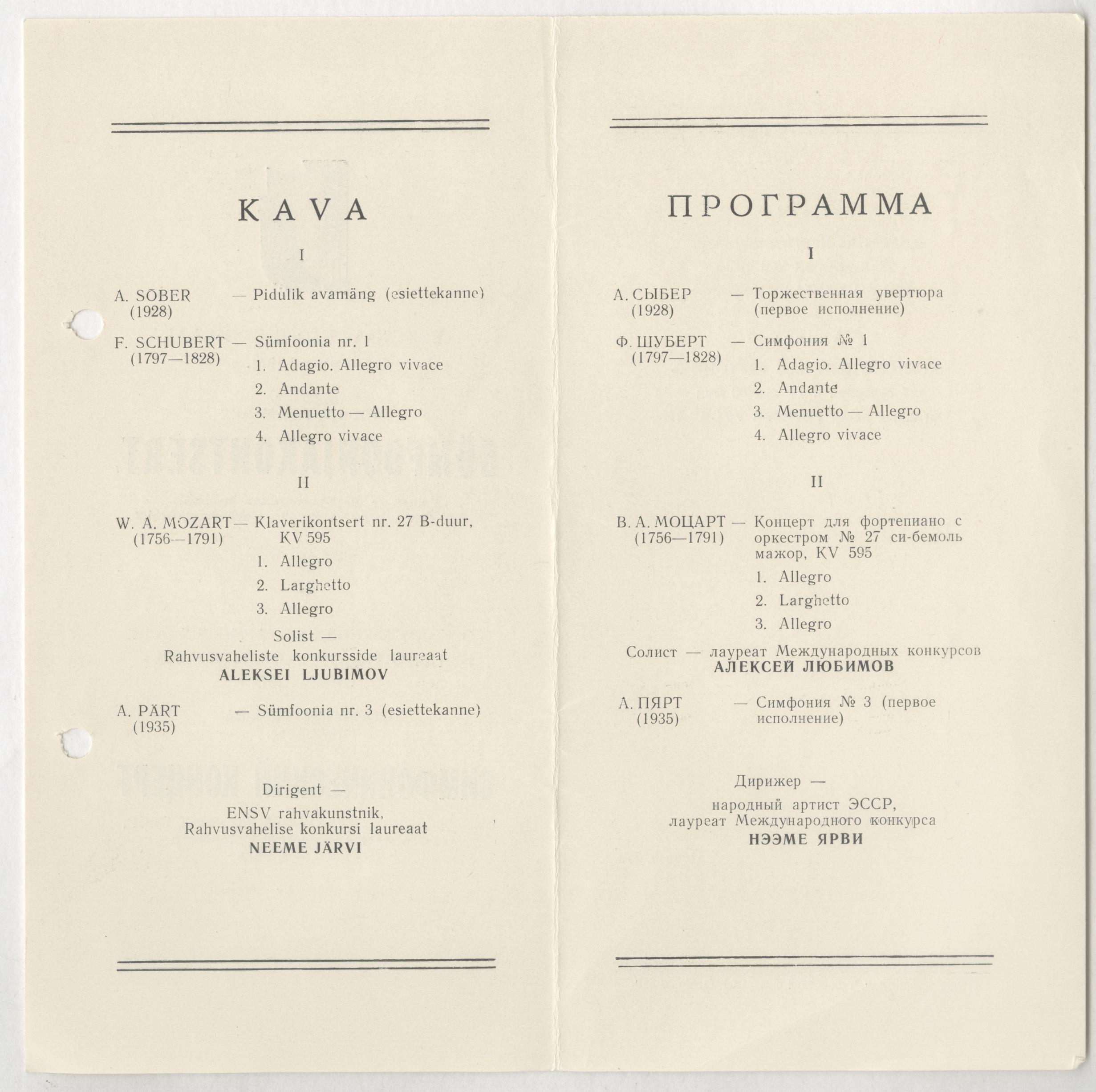
Page from the printed concert programme at the premiere of Symphony No. 3. It was the opening concert of the 1972/1973 season of the Estonian SSR National Philharmonic Orchestra, where Pärt’s new composition was performed as the final piece of the concert. Courtesy of the Estonian Theatre and Music Museum.