Recording of the performance of Lamentate, performed on September 11, 2014 in composer’s birthday concert in Tallinn at St. John’s Church.
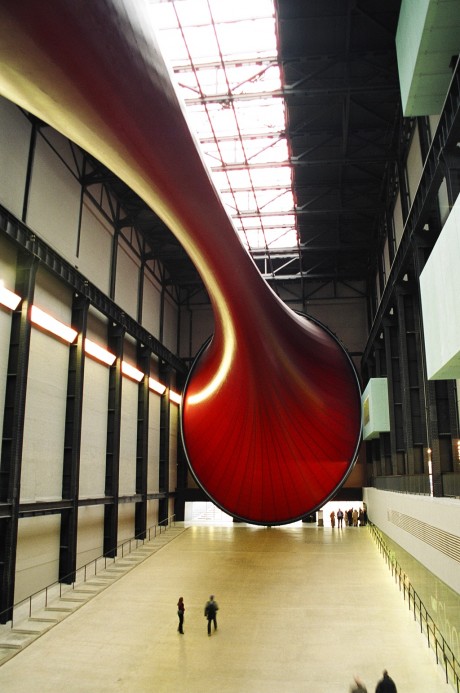
The sculpture Marsyas by Anish Kapoor placed at the Tate Modern Turbine Hall around the time when Pärt’s Lamentate premiered. Photo: Eric Marinitsch / Arvo Pärt Centre.
Recording of Lamentate, performed on September 11, 2014 in composer’s birthday concert in Tallinn at St. John’s Church. Courtesy of Estonian Public Broadcasting.
Lamentate. “Homage to Anish Kapoor and his sculpture Marsyas” (2002) for piano and orchestra
Lamentate was commissioned by the Tate Modern in London and was inspired by Marsyas, the giant sculpture by Anish Kapoor (born 1954), the British sculptor and multimedia artist of Indian origin – hence, the subtitle of the composition. Kapoor’s installation was intended to work in an interaction between visual-spatial and acoustic qualities. In composing the piece, Pärt took into account the specific acoustics of the space where Kapoor’s sculpture was displayed, the turbine hall of an old power station that had become the Tate Modern. This is also where Lamentate was premiered on 7 February 2003, performed by Hélène Grimaud, with Alexander Briger conducting the London Sinfonietta.
In Greek mythology, the satyr Marsyas was flayed alive by Apollo, the god of light, truth and fine arts, for daring to challenge him to a contest of music. Anish Kapoor’s take on the legend of Marsyas was the 155-metre-long, 35-metre-high bright red sculpture, which reminded of a flayed human body. Marsyas consisted of three steel rings joined together by a single span of plastic cover material, forming a trumpet-like shape. Arvo Pärt:
My first impression was that I, as a living being, was standing before my own body and was dead – as in a time-warp perspective, at once in the future and the present. /…/ Anish Kapoor’s sculpture shatters not only concepts of space, but also – in my view – concepts of time. The boundary between time and timelessness no longer seems so important. /.../ And so I have written a lamento – not for the dead, but for the living who have trouble coping with the pain and suffering of this world.
Explaining his choice of the solo instrument, the composer has again referred to Kapoor’s sculpture which, regardless of its vast size, leaves an ethereal and floating impression. Likewise, the piano as one of the largest musical instruments allows a warm and intimate atmosphere to be created. Consequently, the composition is shaped by two polar forces: brutal robustness and intimate fragility that alter throughout the composition mutually influencing each other.
There are two liturgical texts hidden in the music. A troparion reflecting upon death in the Orthodox Prayer Book brings the dimension of eternal peace to the music. As in many other of the tintinnabuli works by Pärt, here too the text of the troparion is carefully engraved into the sounds, considering the number of syllables, punctuation marks and other parameters of the text in the creation of the music. However, the dramatic culmination of the first musical passage is unravelled by the Dies irae sequence from the Mass for the Dead (Requiem).